
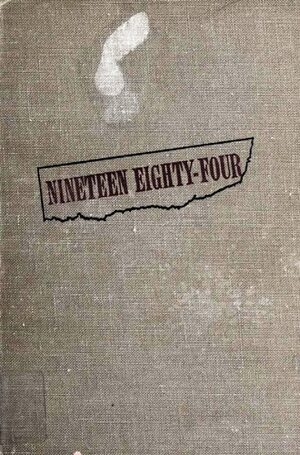
1984 book review: Nineteen Eighty-Four by George Orwell
Is 1984 a good book?
Nineteen Eighty-Four is best suited for mature young adult readers who appreciate thought-provoking, slow-paced dystopian fiction. The story follows Winston Smith, a low-ranking clerk in a totalitarian state where surveillance and control permeate every aspect of life. The book unfolds with a deliberate, slow pacing and features closed door scenes regarding intimacy. It contains long torture sequences that serve as a main content warning. This standalone novel offers a chilling exploration of power and resistance without any sequels or series continuation.
Spice level, tropes and content warnings
Spice runs from 0, no sexual content, to 5, explicit and central to the plot. The rating is the site's overall score from 1 to 5 in half steps. Tropes and content warnings come from the book itself. See how Fiction Lists rates books.
- Spice
- 1 of 5, Closed door: kissing only; scenes cut away (closed door)
- Age group
- Young adult
- Tropes
- War, Forbidden love
- Content warnings
- torture, abuse, violence, sexual assault, addiction
- Rating
- 4 / 5
| Level | Label | Meaning |
|---|---|---|
| 0 | None | no sexual content |
| 1 | Closed door | kissing only; scenes cut away (closed door) |
| 2 | Low detail | one or two on-page scenes, low detail |
| 3 | Explicit | several explicit scenes; the plot carries the book |
| 4 | Frequent | explicit and frequent |
| 5 | Central to the plot | explicit, frequent and central to the plot |
1984 book age rating and reading level
This site classifies 1984 as a young adult novel for two reasons: the intimate scenes are discreet, with kissing on the page and the rest cut away, and the prose is straightforward enough for teenagers. The age suitability mainly hinges on the intense torture chapters toward the end rather than the romantic elements. It is commonly assigned in the final years of high school, and readers disagree about the right age. Some believe readers as young as 13 or 14 can understand it, while others say they were glad they waited until adulthood.
The prose of the book is plain, using short declarative sentences and everyday vocabulary. Invented Newspeak words are explained where they appear and again in the appendix, so no glossary is needed. The challenging aspects come from the ideas, the essay chapter in Part Two, and the bleak mood that never lifts. The language itself is accessible, allowing younger readers familiar with plain adult fiction to manage the words, while the mood is the true test of their readiness for the book.
What to know before reading 1984
Torture is the most prominent warning associated with the book, appearing late in the story with detailed descriptions of beatings, starvation, sleep deprivation, and a pain machine. These scenes extend over many pages, focusing more on breaking the mind than the body, with minimal gore. The abuse warning also includes brainwashing, interrogation, and children trained to inform on their parents. The protagonist, Winston, carries deep guilt about his mother and younger sister, who disappeared during his childhood.
Violence forms a constant backdrop with rocket bombs falling on London, a war newsreel showing a refugee boat bombed, and enemy prisoners publicly hanged while Parsons' children plead to watch. A sexual assault warning appears in Part One when Winston imagines flogging and raping Julia during the Two Minutes Hate. The affair itself is closed door, and Julia says plainly that she has had many lovers. Victory Gin is consumed continually as the sole comfort, cigarettes are everywhere, which is the addiction warning, and swearing remains mild throughout the narrative.
The book is divided into three sections plus an appendix. Part One moves slowly. With hardly any plot events, it creates the world through the diary, the Records Department, the Two Minutes Hate, a stroll through the prole district, and the junk shop. The affair takes place in Part Two. Many readers cite chapter 9 of Part Two, a lengthy excerpt from Goldstein's banned book that reads like a political essay, as the point where they stop reading. Many refer to Part Three's rapid pace as the reason the book is a classic. A brief article about the created language is included in the appendix on Newspeak.
Why was the book 1984 banned?
Since the 1950s, the book has been challenged from both political sides in US schools and libraries. Some challengers saw it as an attack on their own government, while others considered it as a pro-communist book with excessive sex. The same argument is missed in both interpretations: the book criticizes all one-party states, regardless of the flag they fly. Additionally, it was prohibited in the Soviet Union until 1988, and readers behind the Iron Curtain who managed to obtain a copy said it accurately depicted their lives. By today's standards, nothing in the text is explicit, and each challenge says more about the year than the book.
1984 book Big Brother: the face on the poster
Big Brother is the face of the Party and the only name the state puts on its power. He is described as a man around 45 years old with a heavy black moustache, and his portrait is displayed on every landing and wall beneath the words BIG BROTHER IS WATCHING YOU. The eyes in the image appear to follow anyone who passes. Every victory, every invention and every ration increase is credited to him, while all failures are blamed on Emmanuel Goldstein, the Party's declared enemy. Big Brother never appears in person, and no one in the book has met him.
The telescreen is a screen in every Party member's home and workplace that simultaneously broadcasts and records and cannot be switched off by ordinary members. The Thought Police watch through it, and nobody knows when they are watching. This is why the name has outlived the book. Since 1949 Big Brother has been the everyday English term for a state that watches its citizens and and it gave its name to a reality television show centered on nonstop camera monitoring. The poster's words also come up whenever a new surveillance law or camera system is debated.
1984 book facts: pages, year and genre
- Author
- George Orwell
- First published
- 1949
- Pages
- 304
- Genre
- Science fiction
- Age group
- Young adult
- Series
- Standalone
- ISBN-13
- 9781328869333
- Updated
- 2026-09-08
Questions about the 1984 book
What age is 1984 appropriate for?
A widely used parents' guide assigns the book 1984 an editorial age recommendation of 16 and up, while its parents and its teens both say 14 and up. Customer ratings at a major retailer also indicate a reading age of 16 and above. This site categorizes the book as young adult. The story's affair remains behind closed doors, but the torture late in the book is what sets the age.
Why was the book 1984 banned?
Jackson County, Florida, in 1981 is the most frequently referenced US case. The book's sexual material, which amounted to a closed-door affair and one violent fantasy in Part One, was criticized by that challenge, which also called the book pro-communist. Abroad, the Soviet Union kept the book banned until 1988, nearly four decades after it was first published.
Who is Big Brother in 1984?
Big Brother is the Party's public face and symbolizes its power. In Oceania, he appears as a portrait and a voice but never as a person in a room. The story leaves it unclear whether he is a living man or an invention, sustained because a face inspires love and fear more effectively than an organisation does.
Who are the main characters in 1984?
Winston Smith, 39, a clerk in the Records Department who seeks proof that the past was once different, is the main character. Julia, 26, works in the Fiction Department and desires a private life rather than a revolution. O'Brien is the Inner Party member Winston trusts. Other characters include Goldstein, the official enemy; Syme, who compiles the Newspeak dictionary; Katharine, Winston's estranged wife; and the proles, the ignored majority.
What are the main themes of 1984?
The main themes of 1984 focus on control over the past, language, and feelings: records are rewritten, Newspeak limits thought, and the Two Minutes Hate directs emotion. Beneath this lies a battle over truth itself, summed up in the Party's claim that two plus two equals five. Private loyalty to loved ones or memories is the sole form of resistance, and the proles are the only hope.
How long is the 1984 book?
This edition has 304 pages and was published as a paperback in 2017. Other editions range from about 248 to 368 pages, depending on type size. The material is divided into three sections of 8, 10 and 6 chapters, with an appendix on Newspeak. Many readers complete it in one or two days, while others finish in a single afternoon.
What reading level is 1984?
Orwell wrote 1984 in short sentences with everyday vocabulary, so the book is easy to follow word for word. A strong reader aged 13 or 14 can follow it. The hardest parts are the essay chapter, chapter 9 of Part Two, which reads like a political tract, and the bleak mood. Most schools assign the book in the last two years of high school.
What is the book 1984 about?
It is 1984, or so the narrator thinks, in Airstrip One, formerly Britain and now a province of Oceania, one of three superstates engaged in constant war. Winston Smith, a clerk responsible for rewriting history, begins a secret diary and then a forbidden love affair, both punishable by death. The novel is a standalone dystopian political work shelved as science fiction.